“Some words want to be played”:
Jim Clark writes poetry with an ear for music
With roots in Tennessee – first Byrdstown and then Cookeville – it is perhaps little wonder that Jim Clark has music in his bones, even if poetry is woven through the very ventricles of his heart. For over thirty years he has made his home in the eastern North Carolina city known for its historic tobacco market, barbecue, and whirligigs. With Clark’s influence as professor emeritus at Barton College, perchance it’s time for Wilson’s claims to fame to expand in the literary realm.
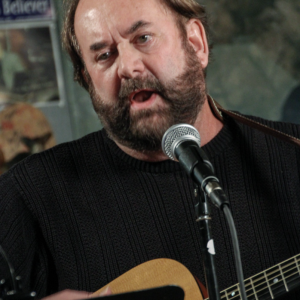
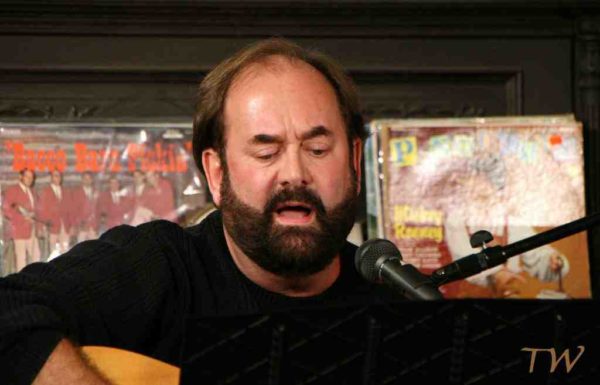
Photo by Tom Whelan
Clark migrated to Wilson in 1994 to teach creative writing at Barton College, having lived in North Carolina before that, pursuing his MFA in creative writing in Greensboro. He taught at Barton for 25 years, retiring in 2019. During his tenure he taught courses in the Department of English and Modern Languages, eventually becoming department chair, and then Dean of the School of Humanities.
Even though Clark has always been a man of words, a second disciplinary pillar that clearly colored his world is music. His father was an early influence, playing guitar, dobro and mandolin, and his uncle was a harmonica player. In high school he began discovering singer-songwriters like Bob Dylan, Neil Young, and Gordon Lightfoot. He loved John Denver and Joni Mitchell, too, and his interest skyrocketed. Clark said he purchased his first “really decent” guitar in high school.
“I was a bit shy in social situations, when young, and playing guitar was a way of getting a little attention without having to be all that social,” he said. Acknowledging his wide-ranging musical taste, Clark said when he was young he listened to the radio constantly and loved the great hits of the 1960s. So he got into pop, rock, and modern folk.
“As I’ve gotten older, my interest in the roots of all this music has grown, and I love blues, old-time country music, and ‘mountain music,’” he said. “There’s still a lot of excellent new original music out there, but for me, it’s not the kind that’s popular and commercially available. I seek out Americana, roots music and that kind of thing.”
From the outside, it would seem that poetry and song lyrics are two strokes from the same brush, practically synonyms. So how does Clark determine when some words long for an accompanying melody, while others are content to live in spoken or written form only?
He explained: “When I set some of the poems of the Georgia ‘farmer-poet’ Byron Herbert Reece to music, some of his poems immediately jumped out to me as ‘song material,’ and others definitely not. With songwriting–and I’m not very prolific–I almost always start out by humming a tune with maybe a few words, a phrase. I almost always have my guitar with me, too, to try things out. If I’m lucky, that little snippet of music and words will form the nucleus of a song that grows out of it. To be honest, I don’t consider myself much of a songwriter. I’m a better poet, I think.”
Having played a number of times at R.A. Fountain General Store, Clark’s most recent performance was in January this year when he joined other singer-songwriters there for a tribute concert to Bruce Piephoff. Clark met Piephoff when he moved to Greensboro in 1976 to attend UNC-G.
“Bruce was a few years older than me and was already a pretty serious songwriter and musician,” Clark said. “I was kind of in awe of him and just kept in the background back then. I got to know Bruce better over the years after I moved back to North Carolina in 1994.”
Clark has played in a number of collaborative configurations, including Coat and Tie with Ben Greene, and jammed with other musicians in the area that eventually became the group Rough Mix.
“We often dreamed of recording an album, but back then, that was a complicated and expensive proposition, and we were hardly more than poor college kids,” Clark said. “When I took the job at Barton College, I was excited to learn that Barton had a nice audio studio on campus as part of its audio recording technology program. I became friends with Phil Valera, the director of that program, and he and I and a few others collaborated on my first CD, Buried Land, a mix of spoken word poetry and traditional folk and country tunes. Eventually, I invited all my old friends to spend a week in Wilson one summer and try and record an album’s worth of material in the Barton studio with Phil as our co-producer and engineer. That became our first album, Wilson. We repeated that process two more times over the next decade or so, leading to our second album, Words to Burn, and our third, And into the Flow. In between those, Phil and I recorded an album’s worth of my musical settings of Byron Herbert Reece’s poems, The Service of Song.
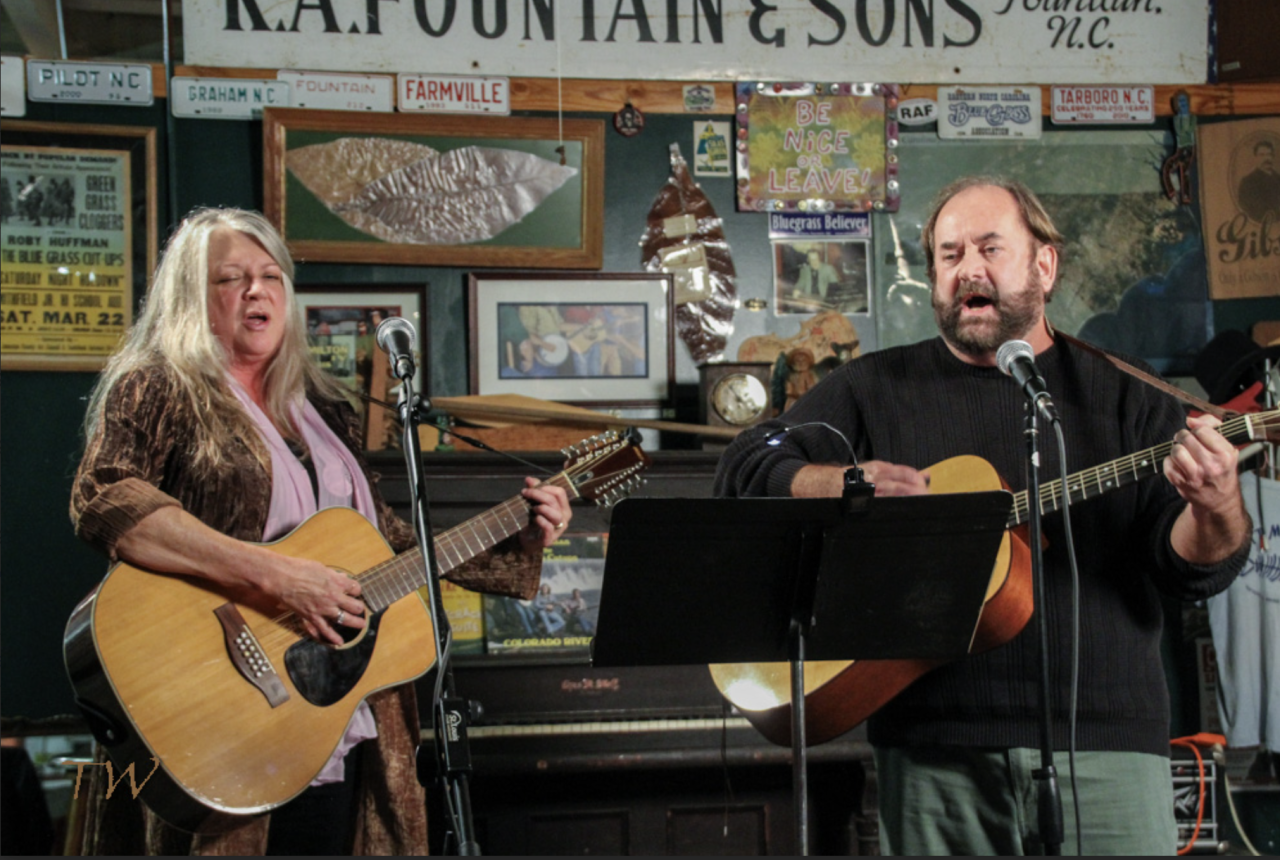
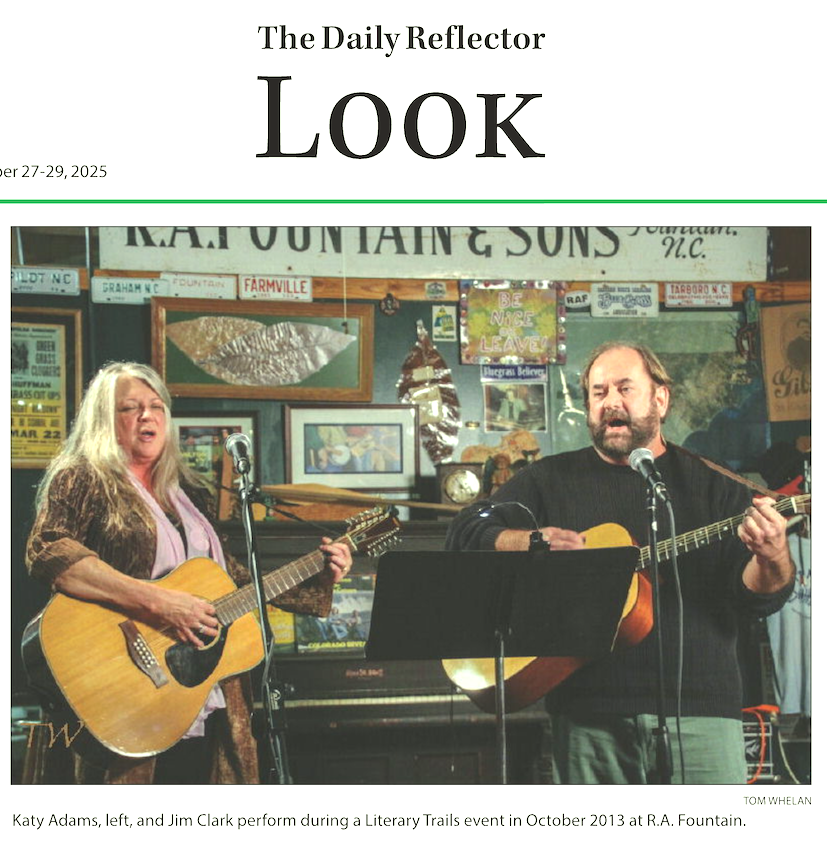
Two of the Near Myths, Katy Adams, left, and Clark. Photo by Tom Whelan
He also plays with the occasional band the Near Myths.
Among his many publications is Fable in the Blood: The Selected Poems of Byron Herbert Reece, published in 2002 by the University of Georgia Press.
These days Clark has a “music room” where he keeps all his instruments readily available and says he doesn’t go long without “fooling around” on one of them.
“Playing music is for me a kind of meditation,” he said. “It calms me, which I need these days, and to play something well, or create something new, gives me a sense of accomplishment, which is a positive thing.”
Clark expressed the frustrations and difficulties of songwriting in an essay,“Tongue-tied, with Sore Fingertips, and Little to Show” [included in his collection Notions: A Miscellany] Not only would his listeners be so bold as to disagree with him, but they likely would characterize even his form of public apology as a work of textual art.
• • •
Originally published in the Daily Reflector, September 27, 2025