- 6754 E. Wilson St., Fountain, NC 27829
- 252.749.3228
- My Account
Location: R.A. Fountain
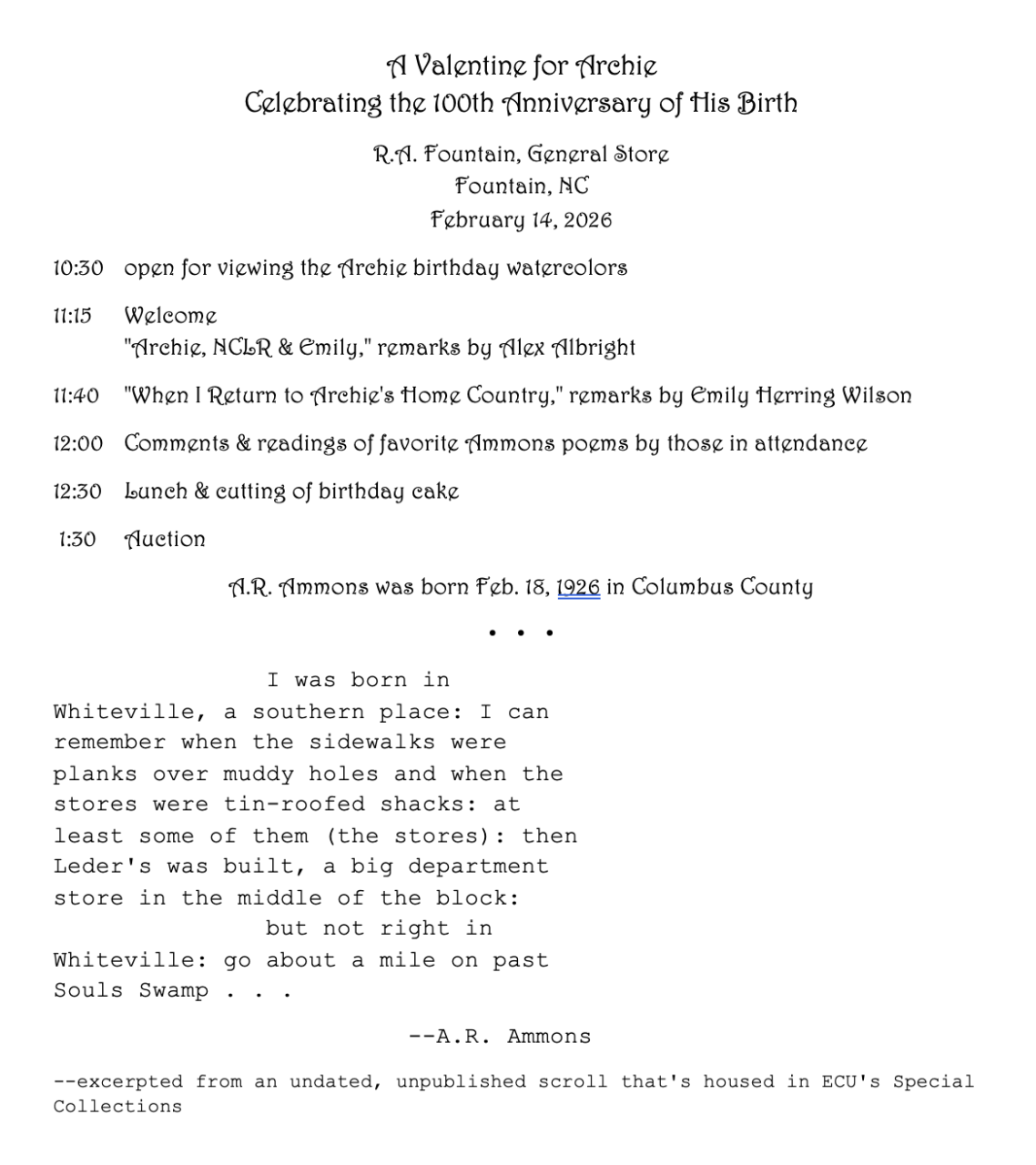
Please consider reading to us a favorite Archie poem & introducing it with remarks about
your own home country.
If you’re interested in lunch ($10 B’s Barbecue etc), please reserve by emailing [email protected] by February 13. You’re also welcome to bring along your own picnic lunch. Cake & ice cream for all.
• • •
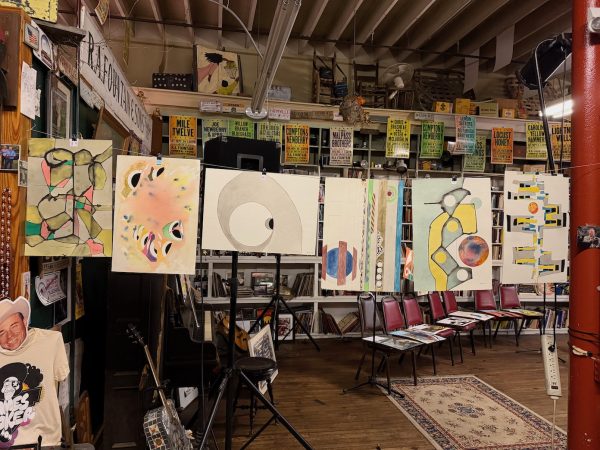
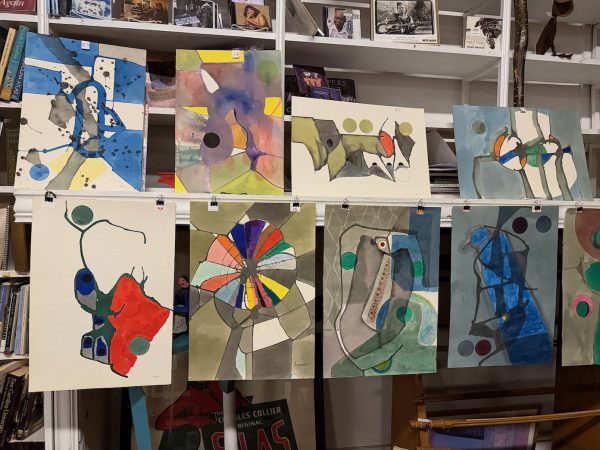
RAF’s pop-up art gallery (detail)
Archie’s Art for Sale, update
Watercolors unsold in our pre-sale will be on display today for in-store purchase and the sale also goes public today: still $100, but open to the public.
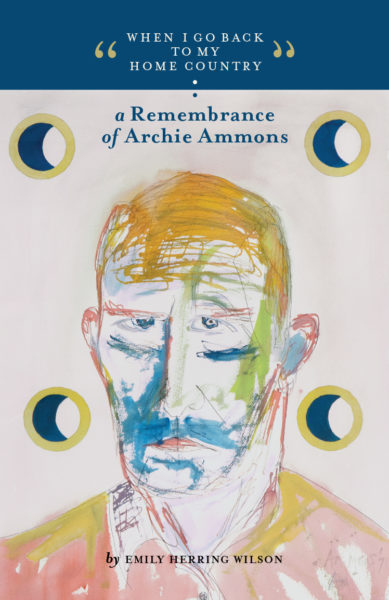
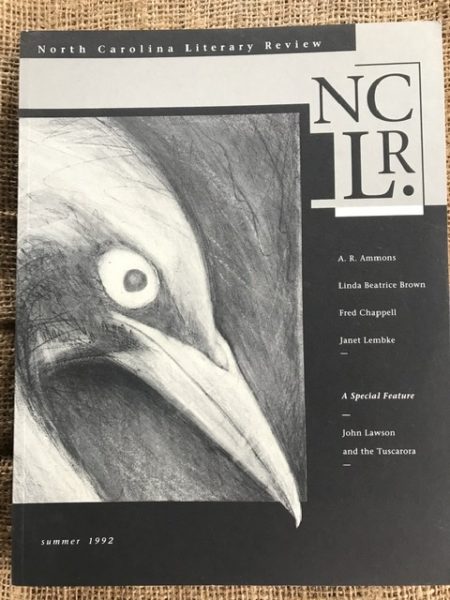
Archie’s 100th birthday package includes an original Ammons watercolor; a copy of When I Go Back to My Home Country, Emily’s memoir about her decades-long friendship with Archie; and a collectible copy of the first NCLR, which introduced Archie as its staff poet in 1992.
View the collection from 10:30 – 11:15, when our 90-minute program will begin.
A few watercolors will be auctioned off after lunch.
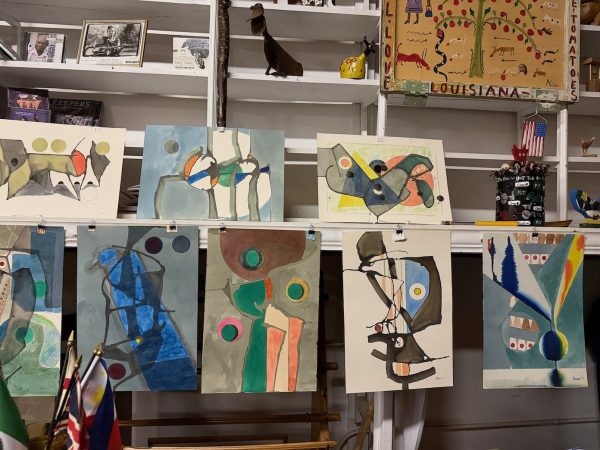
Archie watercolors pop up all around our store’s interior, Feb. 14 only.
Meanwhile, here are two interesting essays on a couple of Archie’s other countries:
First, Jonathan Pattishall’s thoughtful & well-written consideration of Archie’s coastal Carolina country–although sister Vida would not have cared for the characterization of their family as poor.
And this personal and elegaic essay, from the Cornell Daily Sun, May 2, 2022, by a student about their walk across Archie’s Cornell country:
A Gold-Finch Eye on Ammons & “The Falls”
by
Amy Wang
Until I heard of the tripartite campus event “Ammons & The Falls,” starting with a walking tour to unveil new displays for two of his poems, I had been ignorant of A.R. Ammons’ status as a major poet. The only reference to him I had seen was on a poster in Goldwin Smith reading “Ammonites.” After a brief search for his name, it’d merely struck me as an endearing pun. Only when preparing to report on the first part of the event did I research more deeply into Ammons.
A. R. Ammons was born in North Carolina on Feb. 18, 1926 and taught at Cornell from 1964 to 1998. For his poetry, he won numerous awards, including the National Book Award. He passed away on Feb. 25, 2001, almost exactly a year before I was born. Eager to remedy my ignorance, I looked into more of his poems. My favorite so far is “Catalyst,” a panegyric to the humble maggot that employs internal rhymes, rollicking enjambment and richly visceral language of decay.
Back to April 26: when I arrived at the first unveiling on Triphammer Bridge, I found literatures in English Prof. Roger Gilbert already there along with a small crowd of onlookers. After introducing myself, I watched as Gilbert made some introductory remarks, thanked people for their contributions — and unveiled the display, previously obscured by a black plastic covering.
Located in an unobtrusive part of the bridge, near the end towards North Campus, the display featured a brief biography of Ammons himself framed by a photo of the falls in winter, while one of them in a warmer season provided a backdrop for the poem, “Triphammer Bridge,” which Gilbert read aloud.
Afterwards, I followed the group across campus towards Cascadilla. Along the way, I struck up a conversation with a local event-goer who went by Norm, who opined that more attention should be paid to poetry’s phonetic elements — the sounds of the words rather than only how people feel about them.
Meanwhile, the tour took us through Goldwin Smith Hall, where Gilbert showed us where Ammons’ former office had been located — and told us of a time when students decorated his office door with garbage after Ammons won the National Book Award for his collection of the same name. Once again, I was genuinely surprised — I must have walked down that hall hundreds of times, yet it never occurred to me that such a figure once had an office there.
Exiting Goldwin Smith, we passed by the small creek that ran near Sage Chapel and the Cornell Store. Apparently, Ammons had written about it as well — until this point, I’d had no idea it had a name, let alone that an award-winning poet had written about a creek named “Wee Stinky.” But so he’d written, and Gilbert read the poem humorously.
Not until the walk along Cascadilla Gorge Trail did I catch up to the professor once more. When asked if he’d known Ammons personally, Gilbert said yes, he’d known him from 1987 through 2001, when Ammons passed away. “Although, I was reading and admiring his work before that,” continued Gilbert. “In fact, I was writing about him in my dissertation before I came to Cornell. When I hadn’t yet decided to attempt the job, he called me up at home and I was just flabbergasted.”
Soon we had reached the second unveiling, close to the Schwartz Performing Arts Center. Here, there was a little mishap — apparently the display had become uncovered and Gilbert had to rush over to re-cover it. Someone also noticed a small typo “[i]” after a line in “Cascadilla Falls,” but otherwise, things proceeded smoothly.
My final question to Gilbert was on which of Ammons’ poems was his favorite. To this, he said, “If I could only choose one poem, I think I would choose one of the long poems … I might choose his long poem, Garbage.” He stressed how hard it was to choose, before naming the poem “Mechanism,” about the inner workings of a goldfinch, as another of his favorites. “This is what [Ammons is] really known for,” he concluded: “Mixing science and natural wonder together, allowing us to see how knowing the science behind things does not in any way diminish their beauty.”
As I left the unveiling, I felt humbled by this rendering of poetry from the scenery that had now become quotidian to me. When one settles into a pattern, it becomes easy to think of these places as mundane. I certainly don’t think constantly of all the people who have passed through Cornell through a century and a half, ordinary students or award-winning poets. I think even less of the names of creeks, or of the precise trajectories by which water crashes onto rock in every gorge.
But Ithaca, like other places, has its own history, stretching back not only through the twentieth century but billions of years into geological time. Perhaps we are all as Ammons’ goldfinch, “unconscious of the billion operations that stay its form,” the layers of our skin like mineral strata stretching far underground.
. . .
Amy Wang is a sophomore in the [Cornell] College of Arts and Sciences. She can be reached at [email protected].
Tags: art auction, discussion, literary, poetry reading